The 1940s Aircraft Aluminum Skin Guide: Alclad, Rivets, Corrosion, and Mirror-Finish Restoration
1940s aircraft aluminum skin restoration covers Alclad identification, rivet patterns, corrosion treatment, polishing stages, panel repair, and preservation records.
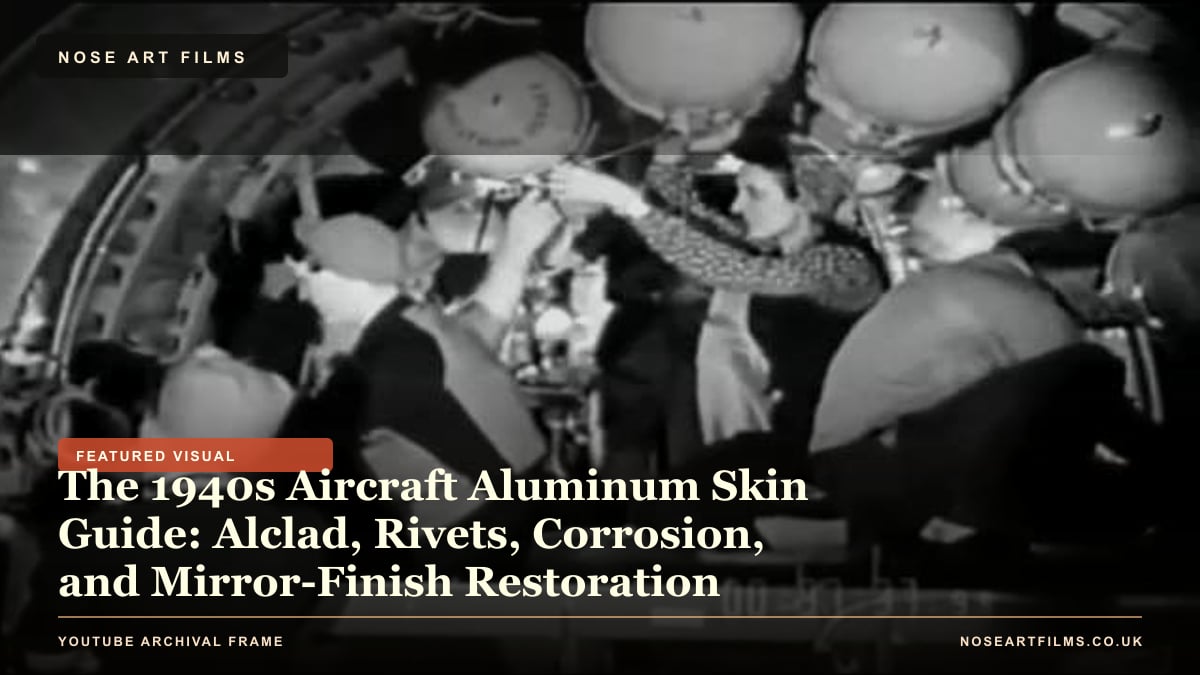
Aircraft skin work at the Willow Run bomber plant comes from a public-domain 1944 production film researched through YouTube and matched to National Archives Identifier 91589. Source: Sources and Visual Credits.
Understanding 1940s aircraft aluminum skin
1940s aircraft aluminum skin is thin Alclad or bare aluminum sheet fastened with rivets to frames, stringers, ribs, and spars. The skin forms an aerodynamic surface, transfers loads, protects internal systems, and preserves visible manufacturing evidence.
Aircraft aluminum restoration starts with 6 identity checks: aircraft model, panel location, alloy callout, temper callout, thickness reading, and rivet pattern. A wing skin, fuselage panel, cowling panel, fairing panel, and control-surface panel use different repair logic.
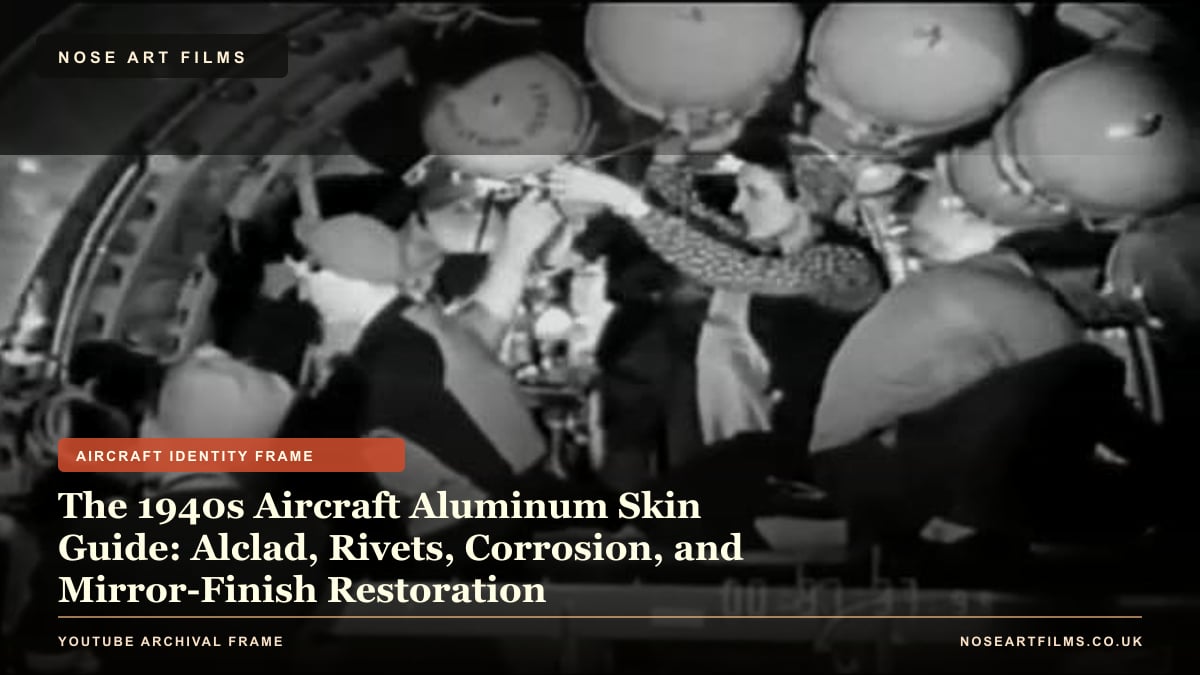
YouTube archival video frame prepared by Nose Art Films for The 1940s Aircraft Aluminum Skin Guide: Alclad, Rivets, Corrosion, and Mirror-Finish Restoration, showing aircraft identity, markings, and film evidence for this blog article.
What alloys were used in 1940s aircraft?
1940s aircraft used 3 common high-strength aluminum alloy groups in repair literature: 2017, 2024, and 7075. Stressed skins often reference clad 2024 sheet, while fittings, forgings, fairings, cowlings, and non-stressed covers use material callouts from the aircraft drawing or maintenance manual.
Alloy names require documentation. Reliable identification uses stamped marks, part numbers, original drawings, repair manual tables, thickness readings, and previous repair records.
How Alclad skin works
Alclad aircraft skin is a high-strength aluminum alloy core bonded to a thin corrosion-resistant pure-aluminum surface layer. FAA corrosion guidance describes this cladding as a protective layer over stronger base alloy.
Alclad restoration protects 2 layers: the corrosion-resistant outer cladding and the stronger structural core. Heavy sanding, repeated cutting compound, and careless corrosion removal expose the core and reduce corrosion resistance.
Identifying vintage aircraft aluminum grades
Vintage aircraft aluminum grades are identified with 6 evidence points: aircraft model, panel location, part number, stamped mark, measured thickness, and repair manual callout. Visual shine alone does not identify alloy, temper, or cladding.
Grade identification improves when 4 records agree: the aircraft parts catalog, the structural repair manual, the panel measurement log, and the restoration photo set. Conflicting records mark the panel as uncertain until expert inspection resolves the difference.
Original aircraft rivet patterns
Original aircraft rivet patterns show fastener type, row count, spacing, edge distance, panel seam location, and load path. Rivet layout identifies factory construction, later repair work, and structural support beneath the visible skin.
Rivet documentation uses 5 simple records: square-on photos, row measurements, head-style notes, seam maps, and patch boundaries. Factory rivets, wartime field repairs, depot repairs, and museum-era patches deserve separate labels.
Structural properties of aircraft skin
Aircraft skin structural integrity depends on material thickness, fastener condition, support structure, crack status, corrosion depth, and repair history. Cosmetic smoothness does not prove stiffness, strength, or fatigue resistance.
FAA sheet-metal repair guidance separates strength from rigidity. A sound restoration restores both properties for flying aircraft, if the aircraft returns to airworthy service.
Preparing aircraft aluminum for restoration
Aircraft aluminum preparation uses 5 ordered steps: document, wash, degrease, inspect, and strip only after evidence is recorded. This order protects factory marks, paint shadows, repair seams, and corrosion clues.
Surface preparation separates 6 materials before polishing: loose dirt, oil, oxidation, paint, lacquer, and corrosion product. Each material responds to a different cleaning method.
Cleaning oxidized aircraft skin
Oxidized aircraft skin cleaning starts with 2 low-risk actions: remove loose dirt and remove oil before abrasion or chemicals. Clean water, mild detergent, and compatible degreaser reveal the true surface condition.
Oxidation assessment separates 3 conditions: light haze, white powder, and pitted corrosion. Light haze belongs in cleaning; pitting belongs in corrosion inspection.
Removing paint from aircraft skin
Paint removal from aircraft skin uses 3 controls: coating identification, worker protection, and small-area testing. Older coatings include primers, topcoats, sealers, and hazardous pigments.
Historic paint deserves documentation before removal. Photograph colors, stencil marks, insignia edges, overspray lines, and repair borders before chemical stripping or mechanical abrasion.
Stripping old lacquer from aluminum
Old lacquer stripping removes yellowed film, trapped polish residue, cloudy sealant, and uneven gloss from polished aircraft aluminum. The work exposes scratches, corrosion stains, and previous buffing trails.
Lacquer removal works best as a controlled test area first, if the finish has display-era value. The test area records how the surface changes before the full panel changes.
Safe acid cleaning for aluminum
Safe acid cleaning for aluminum requires 4 controls: correct product, limited dwell time, complete rinse, and corrosion-inhibiting follow-up. Acid brightens aluminum but also etches edges, seams, and damaged cladding.
Approved maintenance instructions control acid use for airworthy aircraft, if the aircraft returns to flight. Internet recipes do not replace the structural repair manual or corrosion control manual.
Sanding grit sequence for prep
Aircraft aluminum sanding uses the finest grit that removes the defect while preserving Alclad thickness. Each grit step removes metal, and Alclad protection lives in a thin outer layer.
A safe sanding record tracks 5 details: starting grit, final grit, sanding direction, defect location, and inspected thickness. The record prevents repeated material loss during later polishing cycles.
How to polish aircraft aluminum to mirror finish
Mirror-finish aircraft aluminum polishing uses 4 stages: clean, cut, refine, and protect. The result depends on controlled material removal rather than force.
Natural metal finish accuracy depends on aircraft type, factory practice, service theater, repainting history, and restoration goal. A highly polished warbird creates strong display value, but historical accuracy comes from documentation.
Best polishing compounds
Aircraft aluminum polishing compounds fall into 3 functional categories: cutting compounds, refining compounds, and finishing polishes. Cutting removes oxidation and scratches, refining removes haze, and finishing improves reflection clarity.
Compound selection follows 4 surface facts: alloy or Alclad status, oxidation level, scratch depth, and finish goal. Original Alclad panels favor conservative compounds and short work cycles.
Buffing around rivets uses edge discipline. Rivet heads, seams, lap joints, access panels, and skin overlaps collect residue and create halos without careful cleanup.
Removing swirl marks and haze
Swirl marks and haze come from 4 process errors: skipped grits, contaminated pads, dry compound, and uneven pressure. Correcting them means returning to the missed stage, not adding pressure.
Inspection lighting needs 3 angles: direct overhead light, side light, and outdoor reflection. Curved fuselage panels reveal trails that shop lighting hides.
Maintaining polished aluminum skin
Polished aluminum maintenance uses 4 habits: gentle washing, dry storage, residue removal, and periodic corrosion inspection. Bare aluminum oxidizes, fingerprints stain, seams trap compound, and moisture attacks lap joints.
Maintenance logs track 5 recurring items: wash date, polish product, corrosion spots, seam residue, and storage condition. Those records turn a shiny finish into a managed preservation system.
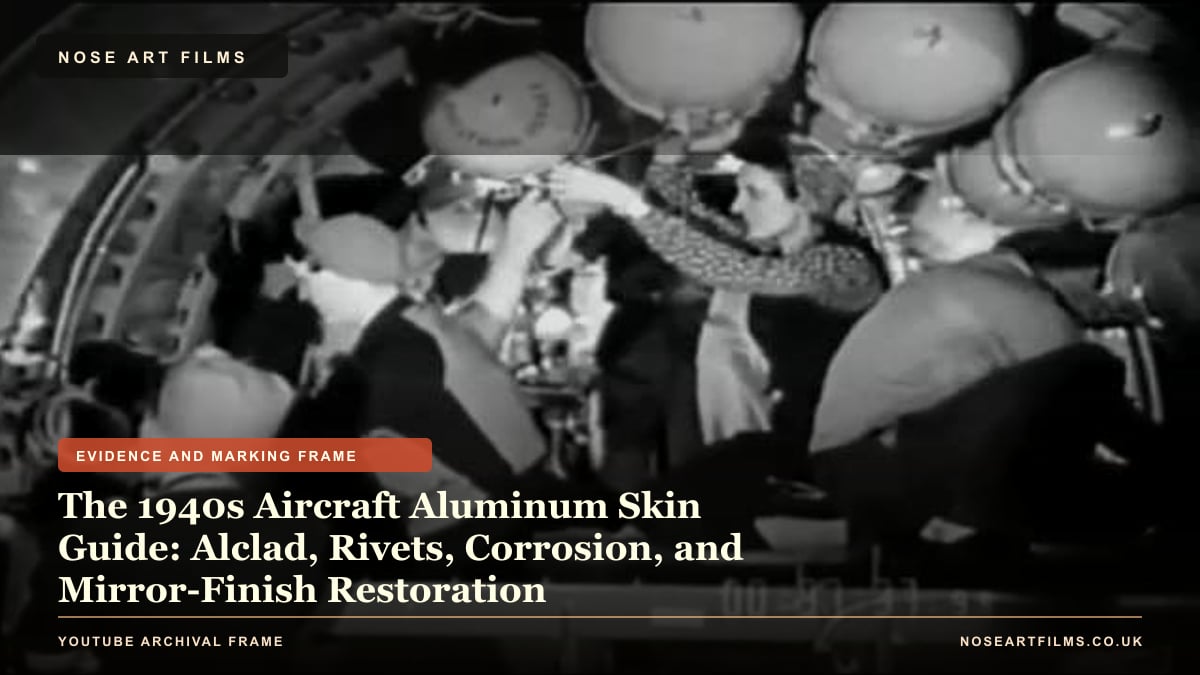
YouTube archival evidence frame prepared by Nose Art Films for The 1940s Aircraft Aluminum Skin Guide: Alclad, Rivets, Corrosion, and Mirror-Finish Restoration, with source status, marking logic, and screen-accuracy cues.
Repairing damaged aircraft skin
Damaged aircraft skin repair starts with 4 classifications: cosmetic dent, corrosion damage, crack damage, and previous-repair damage. The classification decides inspection, patch design, and replacement limits.
FAA repair guidance emphasizes 5 sheet-metal basics: matching material, matching thickness, drilling clean holes, deburring edges, and inspecting nearby rivets. Those basics protect the next load path.
Patching aircraft aluminum skin
Aircraft aluminum skin patching uses 4 design checks: damage size, edge distance, fastener pattern, and support structure. Patch shape and rivet layout decide whether the repair distributes load or concentrates stress.
Historic patches require 3 labels: factory repair, service-era repair, and modern restoration repair. Clear labels protect authenticity and reduce confusion for future caretakers.
Replacing aircraft skin sections
Aircraft skin replacement fits 3 cases: excessive corrosion, cracked structure, and previous repair damage beyond approved limits. Replacement restores condition but removes original manufacturing evidence.
Replacement records preserve 6 facts: removed panel location, original thickness, replacement alloy, fastener type, finish system, and reason for removal. Those facts keep the restoration transparent.
Dimpling and riveting techniques
Dimpling and riveting accuracy depends on correct die size, clean holes, aligned sheets, proper rivet length, and controlled driving force. A distorted dimple or overdriven rivet creates stress concentration.
Flush rivets, universal-head rivets, bucking bars, rivet guns, and dimpling dies belong to a matched tool system. Mismatched tools damage holes and distort thin sheet.
Removing dents from aircraft skin
Aircraft skin dent removal depends on 3 conditions: dent depth, stiffener involvement, and rivet-line distortion. A shallow cosmetic dent differs from a crease that affects a stringer or fastener row.
Dent documentation uses 4 views: exterior photo, side-light photo, backside inspection, and rivet-line measurement. The record separates preservation damage from service history.
Structural integrity during repairs
Structural repair integrity depends on strength, rigidity, load path continuity, and inspection evidence. A smooth patch fails the restoration goal when stiffness or fatigue margin is lost.
Qualified maintenance data controls flying-aircraft repairs, if the aircraft returns to airworthy service. Static-display repairs still benefit from the same documentation discipline.
Corrosion treatment for aircraft aluminum
Aircraft aluminum corrosion treatment uses 4 actions: identify corrosion type, remove corrosion product, inhibit remaining metal, and restore protection. Treatment changes when corrosion moves from surface film to material loss.
Aluminum corrosion includes 5 practical categories: surface oxidation, pitting corrosion, intergranular corrosion, exfoliation, and hidden lap-joint corrosion. Each category carries a different inspection threshold.
Treating surface and pitting corrosion
Surface corrosion and pitting differ by material loss: oxidation sits on the surface, pitting cuts into the metal. Pitting reduces thickness and concentrates stress.
Pitting inspection uses 4 tools or methods: magnification, depth measurement, thickness reading, and qualified nondestructive inspection. Approved repair limits control the final decision, if the panel belongs to an airworthy aircraft.
Preserving the Alclad layer
Alclad preservation protects the thin pure-aluminum cladding that shields stronger alloy underneath. Cleaning removes contamination; restoration does not casually remove protective metal.
Alclad risk rises during 4 actions: sanding, heavy cutting, corrosion scraping, and repeated buffing. Each action receives a stop point before the outer layer disappears.
Protective coatings for aircraft skin
Aircraft skin protective coatings include conversion coatings, primers, paint systems, waxes, and corrosion-inhibiting compounds. The correct coating depends on display status, flight status, storage humidity, handling frequency, and finish goal.
Bare polished aircraft, painted warbirds, stored spare panels, and outdoor museum displays use different protection schedules. The coating plan follows the aircraft environment.
Inspecting hidden corrosion
Hidden corrosion inspection targets 5 moisture traps: lap joints, seams, rivets, paint blisters, and closed structures. A polished exterior does not prove a clean interior.
Inspection access uses mirrors, borescopes, removable panels, lighting, and nondestructive testing. The access method follows the structure and the suspected corrosion path.
Maintaining restored aircraft aluminum
Restored aluminum maintenance uses 5 records: cleaning date, inspection result, corrosion location, repair action, and next review date. Records prevent the same panel from receiving untracked polish or chemical treatment.
Long-term maintenance combines dry storage, clean seams, compatible fasteners, controlled handling, and periodic review. The result is preservation rather than repeated cosmetic rescue.
Tools, costs, and restoration decisions
Aircraft skin restoration tools divide into 6 categories: documentation tools, cleaning tools, inspection tools, metalworking tools, polishing tools, and preservation tools. Each category belongs to a different restoration phase.
Restoration cost depends on 6 cost drivers: corrosion depth, access difficulty, panel size, documentation gaps, fabrication labor, and airworthiness status. Labor and inspection usually outweigh compound and cloth cost.
Thickness gauges and inspection tools
Thickness gauges and inspection tools verify panel thickness, remaining material, rivet condition, seam condition, and corrosion depth. Measurements matter only when compared with approved baseline data.
Useful inspection tools include calipers, ultrasonic thickness gauges, magnifiers, straightedges, lights, mirrors, borescopes, and eddy-current equipment. Each tool answers a specific material question.
Professional aircraft polishing kits
A professional aircraft polishing kit contains 5 item groups: compounds, pads, microfiber cloths, residue cleaners, and protective products. The kit supports stages rather than one aggressive pass.
A preservation-grade polishing kit also contains 4 documentation items: camera, panel map, test-area notes, and product log. Documentation prevents accidental over-polishing across multiple sessions.
Cost of aircraft skin restoration
Aircraft skin restoration cost depends on 6 cost drivers: corrosion depth, access difficulty, panel size, documentation gaps, fabrication labor, and airworthiness status. A removable fairing costs less than a stressed wing skin because access and approval burden differ.
Cost estimates become clearer after 4 inspections: exterior condition, backside access, thickness measurement, and fastener survey. Guesswork before inspection produces weak budgets.
Repair vs replacement decisions
Repair versus replacement decisions compare 4 values: original material, structural margin, labor time, and documentation value. Repair preserves artifact evidence; replacement restores material condition.
A decision record answers 4 questions: what failed, what evidence remains, what approved data applies, and what material changed. That record strengthens both safety and historical trust.
DIY vs professional restoration
DIY restoration fits 2 low-risk categories: non-airworthy display cleaning and removable spare-panel polishing. Structural repair, corrosion limit evaluation, and flying-aircraft work belong with qualified aircraft maintenance professionals.
Professional restoration adds 5 safeguards: approved data, calibrated inspection, correct tooling, repair documentation, and accountability. Those safeguards matter most when errors remove original material or affect airworthiness.
Common mistakes in aircraft aluminum restoration
Aircraft aluminum restoration mistakes cluster into 4 failures: over-polishing, undocumented stripping, incorrect rivets, and ignored hidden corrosion. Each failure removes evidence or reduces repair confidence.
Avoiding Alclad damage
Alclad damage prevention starts with 1 rule: stop removing metal after the defect correction goal is reached. Shine is not proof of preservation.
Over-polishing warning signs include bright edge thinning, rivet halos, uneven reflection, exposed scratches, and recurring haze. These signs mark material loss, not finishing progress.
Preserving original aircraft skin
Original aircraft skin preservation protects 4 evidence types: factory marks, wartime repairs, rivet patterns, and finish layers. These details connect the panel to manufacturing, service, repair, and display history.
Preservation records include photos, measurements, material notes, finish samples, and repair decisions. The record lets future mechanics and historians understand what changed.
Long-term warbird skin preservation
Long-term warbird skin preservation depends on 5 controls: dry storage, clean seams, compatible metals, inspection records, and cautious handling. These controls reduce corrosion, abrasion, galvanic reaction, undocumented treatment, and handling damage.
The best restored aircraft skin gives future mechanics, historians, and visitors 3 things: safe structure, readable evidence, and honest documentation.