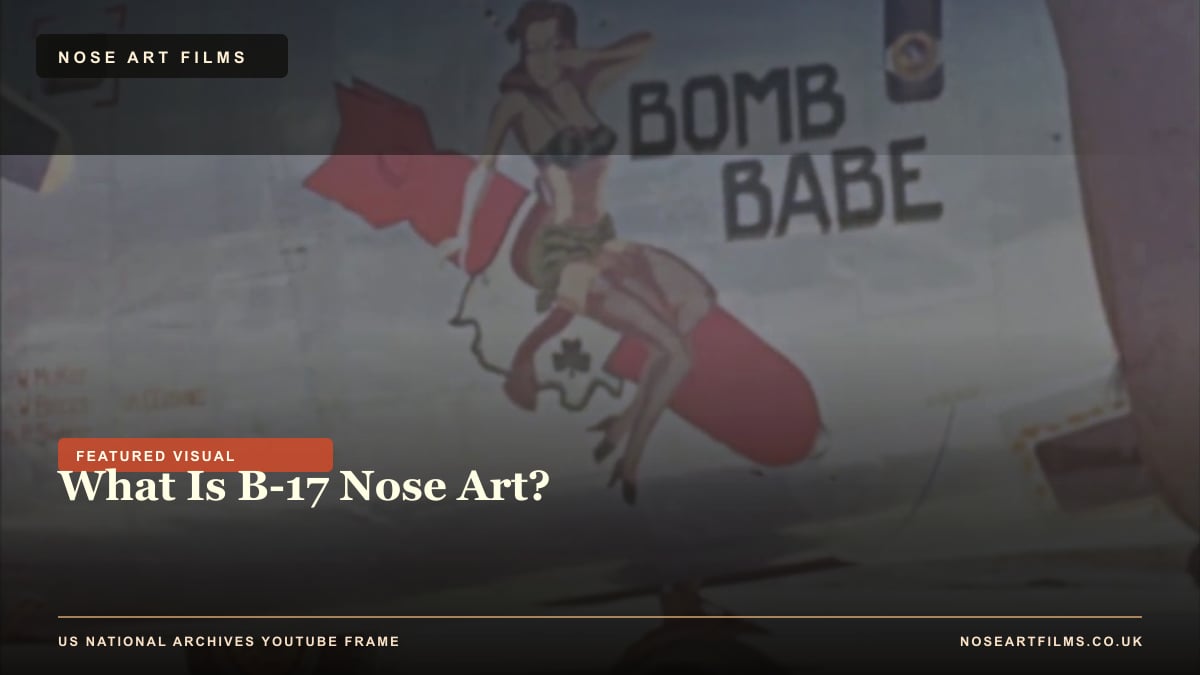
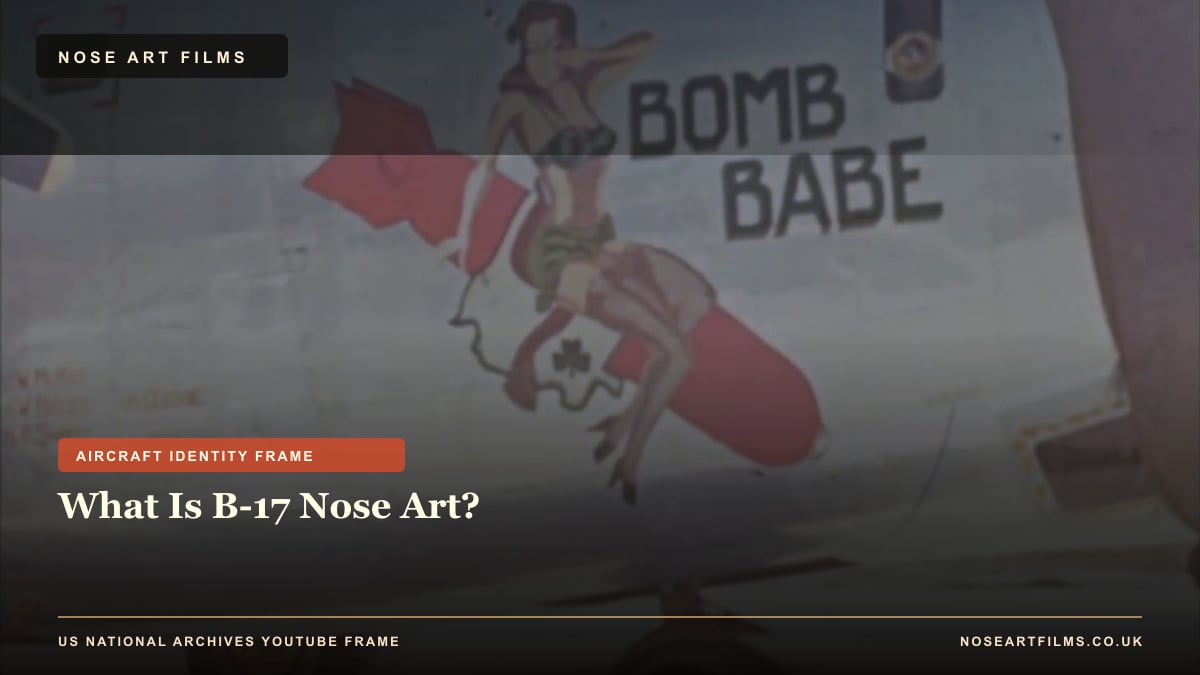
B-17 nose art includes aircraft names, pin-up figures, cartoon figures, patriotic symbols, bomb tallies, combat marks, squadron codes, and crew-related signs.
YouTube archival video frame prepared by Nose Art Films for What Is B-17 Nose Art?, showing aircraft identity, markings, and film evidence for this blog article.
What Did B-17 Nose Art Include?
B-17 nose art included aircraft names, figures, symbols, and mission marks.
B-17 nose art commonly included:
Names: Memphis Belle, Sally B, Boeing Bee
Human figures: pin-up figures, portraits, mascots
Cartoon figures: comic characters, animals, fantasy figures
Patriotic symbols: flags, stars, national signs
Mission tallies: bomb symbols, completed mission marks
Unit identifiers: squadron codes, tail markings, fuselage letters
Why Did B-17 Crews Use Nose Art?
B-17 crews used nose art for crew identity and morale . The artwork gave each aircraft a personal identity inside a large bomber force.
Nose art served 5 functions:
Identified one bomber inside a formation.
Personalized the aircraft for the crew.
Recorded mission experience.
Strengthened crew morale.
Created visible aircraft memory.
What Are the Main Types of B-17 Nose Art?
B-17 nose art has 6 main types : names, pin-up art, cartoon art, patriotic symbols, mission tallies, and squadron markings.
The table below separates B-17 nose art types by aircraft function and movie function.
Nose Art Type
Aircraft Function
Movie Function
Aircraft name
Identifies the bomber
Gives the aircraft screen identity
Pin-up art
Reflects wartime visual culture
Creates period detail
Cartoon figure
Adds personality
Humanizes the aircraft
Bomb tally
Shows mission count
Signals combat history
Kill marking
Shows combat claims
Adds visual evidence of war
Squadron code
Identifies unit context
Supports historical setting
The table separates artwork from identification marks. Both appear in B-17 movie scenes.
Why Is B-17 Nose Art Important in Movies?
B-17 nose art is important in movies because it gives a bomber visual aircraft identity . Nose art helps the audience recognize one bomber among many similar aircraft.
A B-17 formation can contain many four-engine bombers. Nose art gives one aircraft a name, image, and narrative role.
How Does Nose Art Help Viewers Recognize a B-17?
Nose art helps viewers recognize a B-17 through a unique name or symbol . The aircraft becomes easier to follow in takeoff scenes, formation scenes, and combat scenes.
Nose art helps in 3 film situations:
Airfield scenes with many parked bombers
Formation scenes with multiple aircraft
Return scenes with damaged aircraft
Why Do Filmmakers Use B-17 Nose Art?
Filmmakers use B-17 nose art for non-verbal aircraft identity . A painted name or image communicates crew identity without dialogue.
B-17 nose art can signal:
Crew attachment
Combat history
Aircraft survival
Emotional risk
Historical setting
How Does B-17 Nose Art Connect War History and Cinema?
B-17 nose art connects war history and cinema through real bomber culture . Films use nose art to transfer World War II aircraft culture into visual storytelling.
The strongest example is Memphis Belle because the aircraft existed in combat history, wartime documentary film, and later Hollywood cinema.
Which Movies Feature B-17 Nose Art?
The main screen works connected to B-17 nose art are Memphis Belle, Twelve O'Clock High, The War Lover, Air Force, and Masters of the Air.
These films and series show B-17 aircraft, bomber markings, squadron identifiers, or recreated World War II aircraft visuals.
Which B-17 Movies Matter Most for Nose Art?
B-17 nose art research centers on 5 screen works : Memphis Belle, Twelve O'Clock High, The War Lover, Air Force, and Masters of the Air.
The table below shows the main B-17 nose art relevance of each screen work.
Film or Series
B-17 Nose Art Relevance
Main User Intent
Memphis Belle
Real aircraft name and recreated nose art
Historical accuracy
Twelve O'Clock High
Bomber group identity and markings
War film research
The War Lover
B-17 crew culture and aircraft visuals
Movie-specific research
Air Force
Early wartime aviation cinema
Historical film context
Masters of the Air
Modern B-17 recreation
CGI and accuracy
Memphis Belle has the highest relevance because its nose art belongs to a real B-17F aircraft and a major B-17 movie.
What Is Memphis Belle Nose Art in Movies?
Memphis Belle is the most famous B-17 nose art in movies. It connects a real B-17F aircraft, a 1944 documentary, and a 1990 feature film.
The aircraft name, artwork, crew story, and film history make Memphis Belle the central entity for this topic.
Was the Memphis Belle a Real B-17?
Yes. Memphis Belle was a real Boeing B-17F Flying Fortress . The aircraft became one of the most recognized B-17 bombers in World War II aviation memory.
The B-17F variant matters because some movie aircraft used to represent Memphis Belle were later B-17G aircraft.
What Does Memphis Belle Nose Art Mean?
Memphis Belle nose art means aircraft identity, personal naming, and crew memory . The name connected the aircraft to pilot Robert Morgan's fiancee, Margaret Polk, from Memphis.
The artwork has 4 connected meanings:
Personal meaning: Margaret Polk connection
Crew meaning: bomber identity
Military meaning: combat aircraft history
Movie meaning: recognizable screen aircraft
Was Memphis Belle Nose Art Real or Created for the Movie?
Memphis Belle nose art was real wartime artwork before the 1990 movie recreated it. The original artwork belonged to the wartime B-17F aircraft.
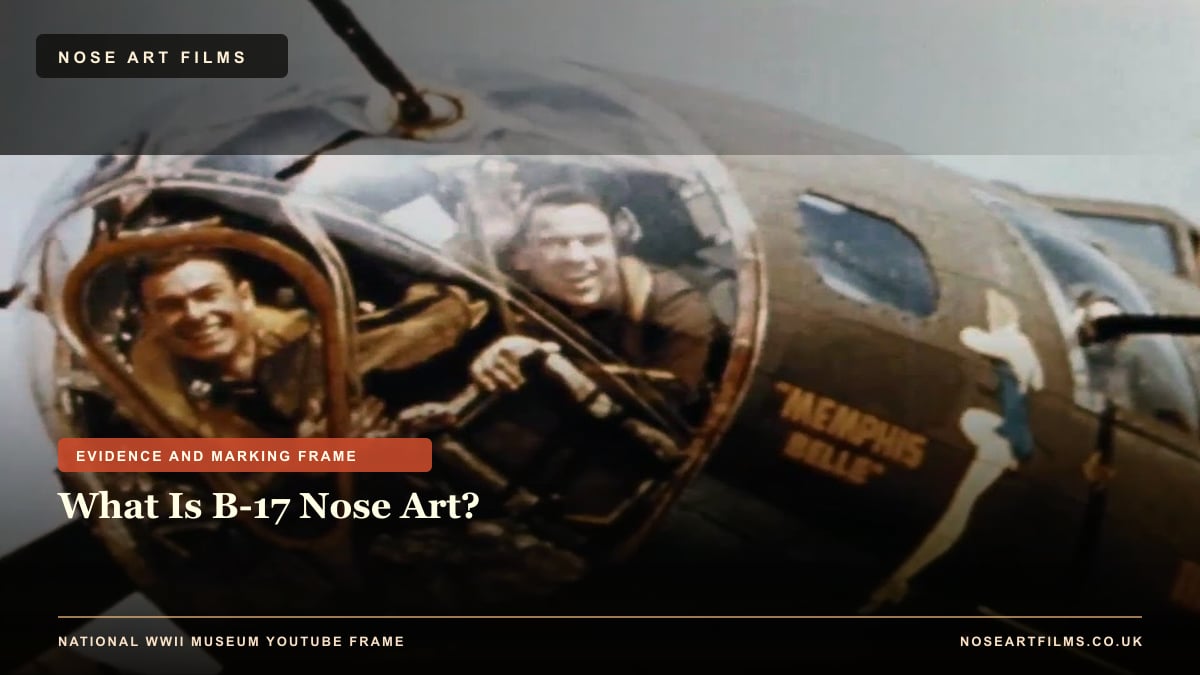
YouTube archival evidence frame prepared by Nose Art Films for What Is B-17 Nose Art?, with source status, marking logic, and screen-accuracy cues.
The movie version was a production recreation. It used surviving B-17 aircraft to represent the original aircraft on screen.
How Did the 1944 Memphis Belle Documentary Affect the Aircraft?
The 1944 Memphis Belle documentary gave the aircraft public wartime recognition . The documentary connected the aircraft, crew, combat missions, and bomber identity for wartime audiences.
The documentary made Memphis Belle a film entity before the 1990 feature film.
How Did the 1990 Memphis Belle Movie Recreate the Aircraft?
The 1990 Memphis Belle movie used real B-17 warbirds and recreated markings . The production needed multiple aircraft because flyable B-17 bombers were limited.
The movie recreated the aircraft through paint, nose art, squadron markings, and airframe modifications.
What B-17 Aircraft Were Used in Memphis Belle?
The 1990 Memphis Belle movie used surviving B-17 warbirds . Some B-17G aircraft were changed to resemble B-17F aircraft.
The original Memphis Belle was a B-17F. The movie production used available aircraft to create a screen version of the wartime bomber.
Why Were B-17G Aircraft Modified to Look Like B-17F Aircraft?
B-17G aircraft were modified for B-17F screen accuracy . The B-17G had later design features that did not match the original Memphis Belle.
The most visible difference is the chin turret. A B-17G has a chin turret. A B-17F does not have the same nose-mounted chin turret.
How Did the Movie Memphis Belle Differ from the Original?
The movie Memphis Belle differed because it used substitute aircraft . The film aircraft were modified, painted, and used for screen continuity.
The table below compares the original Memphis Belle with the movie Memphis Belle.
Attribute
Original Memphis Belle
Movie Memphis Belle
Aircraft type
B-17F
B-17F and modified B-17G aircraft
Purpose
Combat aircraft
Film representation
Nose art
Wartime artwork
Recreated artwork
Markings
Historical markings
Production markings
Accuracy issue
Original source
Airframe substitution
The movie aircraft represented the original aircraft. The movie aircraft were not the original Memphis Belle.
How Accurate Were the Memphis Belle Movie Markings?
The Memphis Belle movie markings were historically based . Airframe substitutions created the main accuracy limits.
Accuracy depends on 5 aircraft attributes:
Variant
Nose art
Paint scheme
Squadron markings
Turret configuration
What B-17 Nose Art Appears in Twelve O'Clock High?
Twelve O'Clock High uses bomber group markings as the main B-17 visual identity. The film focuses more on command pressure and group operations than one famous nose-art aircraft.
Twelve O'Clock High belongs to the B-17 movie network because it uses B-17 aircraft imagery, bomber formations, and unit identity.
Did Twelve O'Clock High Use Real B-17 Aircraft?
Twelve O'Clock High uses real B-17 imagery as part of its screen identity. The film's B-17 relevance comes from bomber realism, aircraft formations, and Eighth Air Force context.
How Does Twelve O'Clock High Compare with Memphis Belle?
Memphis Belle is stronger for nose art identity . Twelve O'Clock High is stronger for bomber group drama.
The table below compares both films by B-17 movie relevance.
Comparison Point
Memphis Belle
Twelve O'Clock High
Main focus
Named aircraft
Bomber group
Nose art prominence
High
Medium
Aircraft identity
Specific B-17
Unit context
Search intent
Nose art accuracy
Bomber realism
What Other Movies and Series Show B-17 Markings?
The War Lover, Air Force, and Masters of the Air belong to the B-17 nose art movie network because they show B-17 aircraft, bomber culture, or recreated World War II markings.
What Is the B-17 Context in The War Lover?
The War Lover is relevant because of B-17 bomber culture . The film uses B-17 aircraft visuals, crew identity, and World War II aviation setting.
What Is the B-17 Context in Air Force?
Air Force is relevant because of early wartime bomber cinema . The film shows U.S. military aircraft identity during the World War II period.
What Is the B-17 Context in Masters of the Air?
Masters of the Air is relevant because of modern B-17 recreation . The series uses Eighth Air Force context, recreated bomber markings, digital aircraft, and production design.
Modern B-17 screen production uses:
Digital aircraft models
Practical cockpit sets
Historical unit markings
Recreated airfield scenes
CGI formation sequences
How Accurate Is B-17 Nose Art in Movies?
B-17 nose art is accurate when the film matches aircraft name, artwork, variant, serial number, unit marking, and paint scheme.
Accuracy decreases when a film uses substitute aircraft, fictional markings, wrong variants, or altered serial numbers.
What Is Real B-17 Nose Art?
Real B-17 nose art is original wartime artwork painted on an aircraft during the aircraft's service life.
Real nose art has 4 accuracy signals:
Original aircraft
Wartime photograph
Known crew connection
Verified aircraft identity
What Is Recreated Movie Nose Art?
Recreated movie nose art is production artwork painted, printed, or digitally applied to represent a wartime aircraft on screen.
Recreated movie nose art can be accurate, partially accurate, or fictional.
Why Do Films Change B-17 Nose Art or Markings?
Films change B-17 nose art or markings because of aircraft scarcity and production limits . Few airworthy B-17 aircraft remain available for film production.
The 5 main causes are:
Limited flyable B-17 aircraft
Substituted B-17G aircraft for B-17F aircraft
Simplified markings for visual clarity
Repeated aircraft identities for continuity
Altered markings for production control
What Are Common B-17 Marking Mistakes in Movies?
The most common B-17 movie marking mistake is wrong variant details . Other mistakes include incorrect squadron codes, wrong paint schemes, fictional serial numbers, and inaccurate turret configurations.
Check 6 features:
Chin turret
Tail position
Waist gun windows
Fuselage letters
Tail markings
Nose art design
How Can Viewers Check B-17 Movie Accuracy?
Viewers can check B-17 movie accuracy by comparing the movie aircraft with historical references . These references include wartime photographs, museum records, serial numbers, squadron histories, and aircraft registry data.
Use this 5-step check:
Identify the aircraft name.
Check the B-17 variant.
Compare the nose art.
Verify squadron codes.
Separate original aircraft from movie substitutes.