Bomber nose art in movies is painted bomber aircraft artwork used to show aircraft names, crew identity, mission history, morale, and wartime aviation atmosphere.
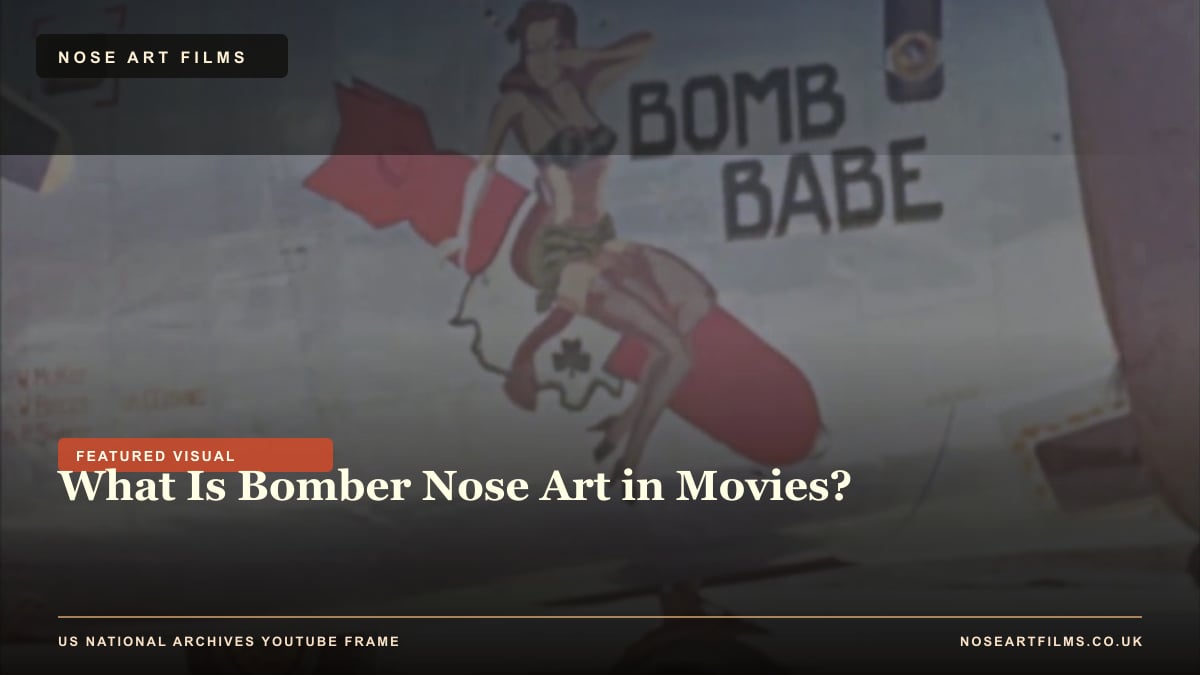
YouTube archival video frame prepared by Nose Art Films for What Is Bomber Nose Art in Movies?. Source: Sources and Visual Credits.
Bomber nose art in movies is painted bomber aircraft artwork used to show aircraft names, crew identity, mission history, morale, and wartime aviation atmosphere.
Bomber nose art appears on the nose or forward fuselage of a bomber aircraft. In movies, bomber nose art helps viewers identify one bomber inside a formation, connect that bomber to its crew, and understand the aircraft as part of the story.
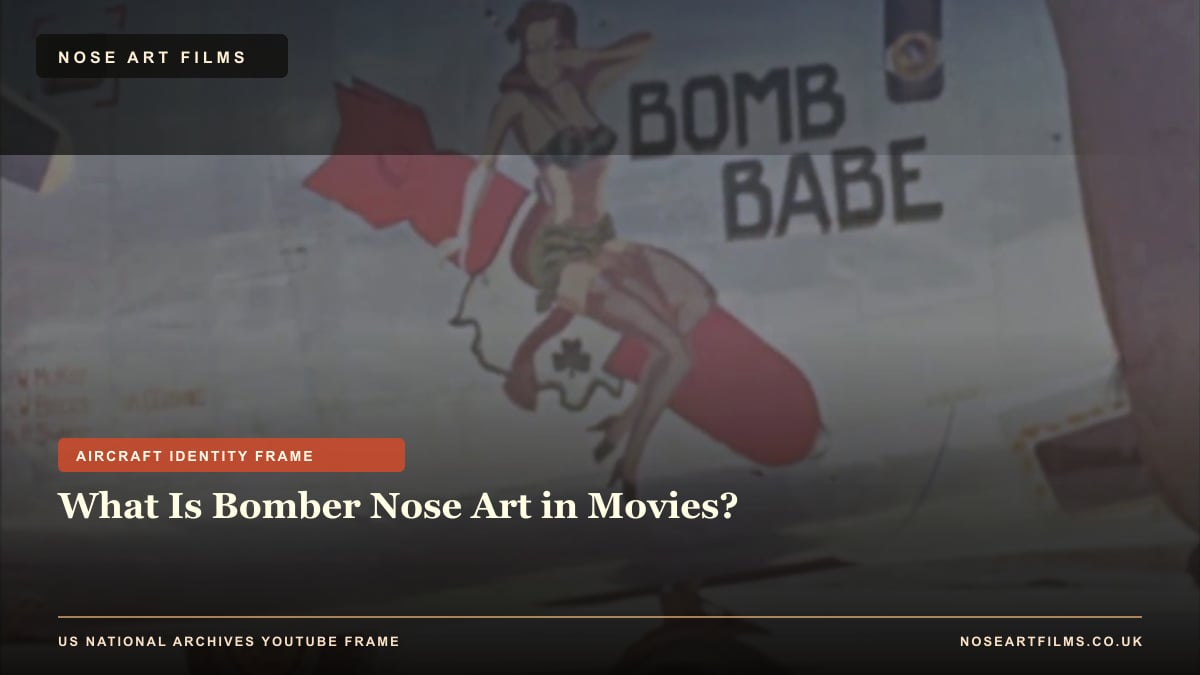
YouTube archival video frame prepared by Nose Art Films for What Is Bomber Nose Art in Movies?, showing aircraft identity, markings, and film evidence for this blog article.
The National WWII Museum states that WWII nose art varied by crew, theater, and aircraft type, while different air forces developed their own nose art styles shaped by national culture. (Decoding WWII Plane Nose Art | The National WWII Museum)
Bomber nose art in movies is judged through 5 main contexts:
Bomber aircraft identity.
Bomber crew meaning.
Historical accuracy.
Movie recreation.
Evidence-based verification.
A strong movie uses bomber nose art for recognition and story meaning without presenting fictional, restored, or generic bomber artwork as documented wartime evidence.
Why Do Movies Show Bomber Nose Art?
Movies show bomber nose art because bomber nose art gives aircraft identity, crew meaning, visual recognition and emotional value.
Bomber aircraft appear in groups, formations, hangars, bombing runs, and return scenes. Nose art helps the viewer follow one bomber and connect that bomber to its crew, mission record, and survival outcome.
What Does Bomber Nose Art Mean in Movies?
Bomber nose art in movies means aircraft identity, crew personality, mission memory, morale, survival and wartime culture.
Bomber nose art can represent:
A bomber crew's identity.
A crew joke or nickname.
A mission history.
A symbol of luck.
A reminder of home.
A visual personality for the bomber.
The meaning is strongest when the bomber name, artwork, serial number, unit marking, mission tally, and scene date support the same aircraft identity.
How Does Bomber Nose Art Create Aircraft Identity in Movies?
Bomber nose art creates aircraft identity by giving a bomber a visible name, symbol, figure, or recognition marker.
Movies use bomber nose art to identify:
Recurring bomber aircraft.
Bomber formations.
Mission aircraft.
Damaged aircraft.
Returning aircraft.
Lost aircraft.
Crew-linked aircraft.
A named bomber is easier to follow than a bomber identified only by model, serial number, squadron code, or tail code.
How Does Bomber Nose Art Represent Aircrews in Movies?
Bomber nose art represents aircrews by connecting aircraft artwork to crew humor, shared danger, crew memory and combat identity.
The aircrew context includes pilots, co-pilots, bombardiers, navigators, gunners, radio operators, ground crews, squadron artists, and aircraft painters.
Bomber nose art works as a human marker. It connects aircraft metal, mission risk, aircraft names, and combat memory to the people who operated the bomber.
How Does Bomber Nose Art Represent Bomber Crews in Movies?
Bomber nose art represents bomber crews through group identity because bombers carried multi-person crews.
Bomber nose art in movies shows:
B-17 crew identity.
B-24 crew identity.
B-25 crew identity.
B-29 crew identity.
RAF bomber crew identity.
Aircraft names.
Mission tallies.
Bomb symbols.
Shared danger.
Crew survival.
Original bomber nose art can survive as physical evidence. The National Aviation Education Center describes its WWII nose art collection as panels cut directly from the noses of WWII bombers. (The Gallery - NAEC | Authentic World War II Aviation Nose Art)
How Are Bomber Aircraft Names Used in Movies?
Bomber aircraft names are used in movies to connect one aircraft, one crew and one mission arc.
Bomber aircraft names can be:
Real aircraft names.
Fictional aircraft names.
Composite aircraft names.
Crew nickname names.
Mission-symbol names.
Character-linked names.
A fictional bomber name can be historically plausible. A fictional bomber name becomes misleading when a movie presents it as a documented real aircraft name without evidence.
How Does Bomber Nose Art Help Viewers Recognize Aircraft in Movies?
Bomber nose art helps viewers recognize aircraft by creating a stable visual identifier.
This function matters in:
Formation shots.
Hangar scenes.
Takeoff scenes.
Mission briefings.
Bombing runs.
Return scenes.
Crash scenes.
A viewer may forget a serial number, but a viewer can remember a bomber name, pin-up figure, mascot, bomb symbol, or painted slogan.
How Does Bomber Nose Art Create Emotional Connection in Movies?
Bomber nose art creates emotional connection by making the bomber named, personal and memorable.
When a named bomber returns damaged, disappears, crashes, or receives repairs, the viewer understands the aircraft's story value faster.
Bomber nose art supports:
Crew attachment.
Aircraft damage.
Aircraft survival.
Mission loss.
Repair scenes.
Audience empathy.
A bomber with a name and artwork becomes more than a generic aircraft in the movie.
Does Movie Bomber Nose Art Romanticize Air Combat?
Movie bomber nose art can romanticize air combat when attractive artwork, heroic names, or humorous symbols hide fear, flak damage, casualties, and crew loss.
Movie bomber nose art can also show real morale, identity, and emotional endurance. The strongest use balances visual appeal with combat danger.
How Accurate Is Bomber Nose Art in Movies?
Bomber nose art in movies is accurate when it matches bomber type, aircraft name, serial number, unit markings, placement, mission tally, bomb symbols, paint condition, scene date and historical evidence.
A movie can look convincing and still be inaccurate when the bomber nose art belongs to the wrong aircraft or when official markings contradict the bomber identity.
This table defines the main accuracy checks for bomber nose art in movies.
Accuracy Factor
What It Checks
Common Movie Error
Bomber type
Whether artwork fits the bomber model
B-17 style art used on another bomber
Aircraft name
Whether the name matches evidence
Fictional name presented as real
Serial number
Whether aircraft identity is correct
Correct art on wrong serial number
Squadron code
Whether unit identity is correct
Wrong unit marking
Tail code
Whether group or aircraft identity matches
Mismatched bomber identity
Placement
Whether art appears on the correct side or panel
Mirrored or misplaced art
Mission tally
Whether mission count fits the scene date
Late-service tallies in early scenes
Bomb symbols
Whether symbols match mission logic
YouTube archival evidence frame prepared by Nose Art Films for What Is Bomber Nose Art in Movies?, with source status, marking logic, and screen-accuracy cues.
Wrong bomb-symbol count
Paint condition
Whether wear matches aircraft use
Over-clean artwork
Scene date
Whether markings fit the timeline
Future markings in earlier scenes
Do Movies Use Real Bomber Nose Art?
Movies use real bomber nose art when the artwork is supported by wartime photographs, aircraft records, museum files, mission records, or original panels.
Movies use 5 bomber nose art categories.
Type
Meaning
Real wartime bomber nose art
Artwork documented on an actual bomber
Restored bomber nose art
Postwar repair, repaint, or museum reconstruction
Recreated bomber nose art
Modern copy based on historical evidence
Inspired bomber nose art
New artwork based on wartime style
Fictional bomber nose art
Invented artwork for a movie bomber
Real bomber nose art needs evidence. The Smithsonian's Robert Serotkin collection contains 32 black-and-white photographs related to aircraft nose art painted while Serotkin served with the US Army Air Forces during World War II. (Nose Art Photography Collection [Serotkin] | National Air and Space Museum)
Do Movies Recreate Bomber Nose Art Correctly?
Movies recreate bomber nose art correctly when the artwork matches the correct bomber, correct side, correct panel position, correct unit, correct mission timeline and correct surrounding markings.
Correct recreation requires:
Correct bomber type.
Correct aircraft side.
Correct panel position.
Correct serial number.
Correct squadron code.
Correct tail code.
Correct mission tally.
Correct bomb-symbol logic.
Correct paint condition.
Wartime photograph or record support.
A correct-looking design becomes inaccurate when placed on the wrong bomber.
What Makes Movie Bomber Nose Art Accurate?
Movie bomber nose art is accurate when it is tied to aircraft-specific evidence.
The strongest bomber nose art accuracy checklist contains 11 items:
Correct bomber type.
Correct bomber name.
Correct serial number.
Correct squadron or group code.
Correct tail code.
Correct artwork placement.
Correct mission tally.
Correct bomb symbols.
Correct paint condition.
Correct scene date.
Wartime photograph or record support.
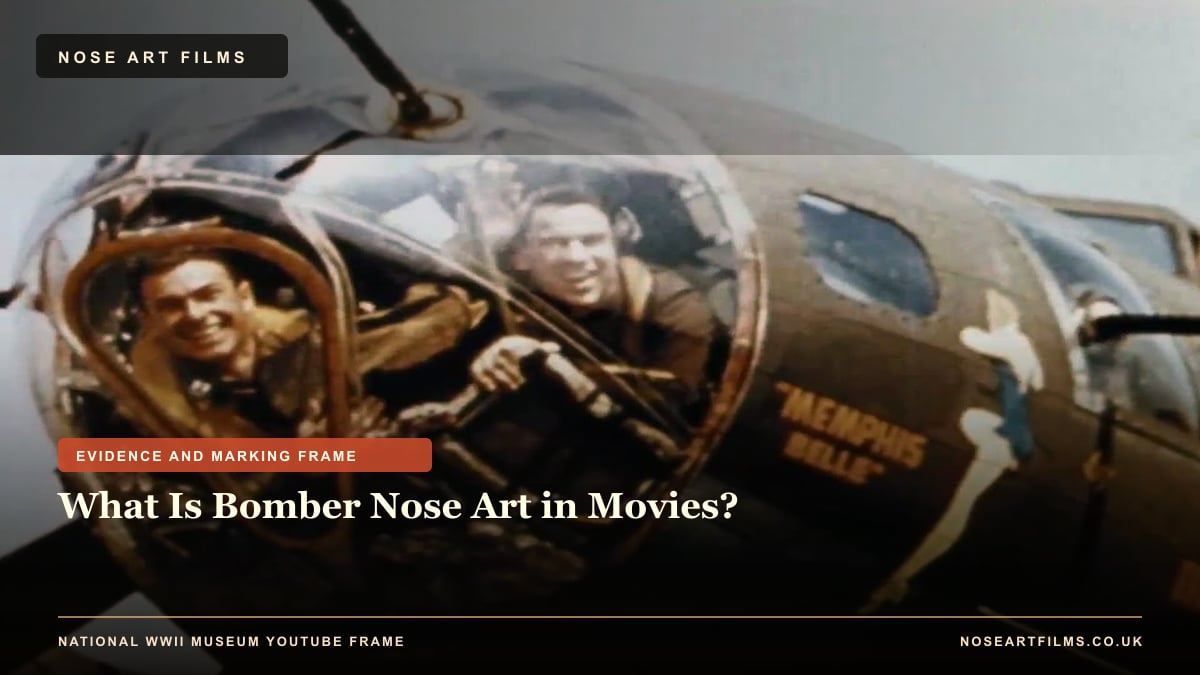
The Memphis Belle shows this evidence standard because the National Museum of the United States Air Force identifies the aircraft as a Boeing B-17F and explains that its nose art represented a George Petty pin-up illustration later touched up and repainted by Cpl. Tony Starcer at Bassingbourn, England. (The Memphis Belle and Nose Art)
What Makes Movie Bomber Nose Art Inaccurate?
Movie bomber nose art becomes inaccurate when it looks period-appropriate but does not match bomber identity, placement, unit, timeline, or evidence.
Common causes include:
Wrong bomber type.
Wrong side placement.
Wrong serial number.
Wrong squadron code.
Wrong tail code.
Wrong mission tally.
Wrong bomb-symbol count.
Modern lettering.
Over-clean paint.
Duplicated CGI markings.
Fictional art presented as real.
The main accuracy issue is bomber identity, not artwork quality.
What Are the Most Common Bomber Nose Art Errors in Movies?
The most common bomber nose art errors in movies are wrong identity, wrong placement, wrong mission logic and over-clean presentation.
Common errors include:
Using real bomber nose art on the wrong bomber.
Placing nose art on the wrong side.
Showing mission tallies that do not match scene date.
Showing bomb symbols that do not match mission history.
Reusing background bombers with identical markings.
Treating restored bombers as wartime-original aircraft.
Presenting fictional bomber art as documented evidence.
How Do Movies Get Bomber Aircraft Markings Wrong?
Movies get bomber aircraft markings wrong when nose art, serial numbers, squadron codes, tail codes, national insignia, mission tallies, or bomb symbols do not support one bomber identity.
The error can happen on practical bombers, restored bombers, replica bombers, background bombers, or CGI bombers.
How Do Movies Confuse Bomber Nose Art with Official Aircraft Markings?
Movies confuse bomber nose art with official aircraft markings when personal artwork and official identification systems are treated as the same thing.
This table separates bomber nose art from official bomber identification.
Marking Type
Meaning
Bomber nose art
Personal artwork or aircraft name
National insignia
Country identifier
Serial number
Aircraft identity
Squadron code
Unit identity
Tail code
Group or aircraft identifier
Mission tally
Bomber mission record
Bomb symbol
Mission or bombing record marker
Bomber nose art gives the bomber personality. Official markings identify the bomber, country, unit, and mission record.
How Do Movies Misuse Bomber Serial Numbers, Squadron Codes, or Tail Codes?
Movies misuse bomber serial numbers, squadron codes, or tail codes when those markings contradict the bomber nose art identity.
A movie bomber becomes inaccurate when:
The serial number belongs to another aircraft.
The squadron code belongs to another unit.
The tail marking does not fit the group.
The mission tally does not fit the scene date.
The bomber type does not match the real aircraft.
Bomber markings work as one aircraft identity system.
How Does Scene Date Affect Bomber Nose Art Accuracy in Movies?
Scene date affects bomber nose art accuracy because bomber markings changed during service.
Scene date controls:
Mission tally count.
Bomb-symbol count.
Damage state.
Repainting.
Unit markings.
Aircraft service history.
An early-mission scene becomes inaccurate when late-service nose art or late-service mission tallies appear without story context.
How Does Bomber Aircraft Identity Affect Nose Art Accuracy in Movies?
Bomber aircraft identity affects nose art accuracy because bomber name, artwork, serial number, unit code, tail code, mission tally, bomb symbols, and scene date must support the same aircraft.
A movie can use accurate artwork and still create inaccurate bomber identity when surrounding markings contradict the nose art.