Accurate Aircraft Nose Art in Movies: Historical Accuracy, Hollywood Recreation, and Real Warplane Markings
Accurate aircraft nose art in movies means screen aircraft art matches the real aircraft, unit, time period, artwork style, and military context.
YouTube archival video frame prepared by Nose Art Films for Accurate Aircraft Nose Art in Movies: Historical Accuracy, Hollywood Recreation, and Real Warplane Markings. Source: Sources and Visual Credits.
Accurate aircraft nose art in movies means screen aircraft art matches the real aircraft, unit, time period, artwork style, and military context.
A movie is accurate when the aircraft name, artwork, serial number, squadron code, paint scheme, mission marks, and aircraft type fit the historical record.
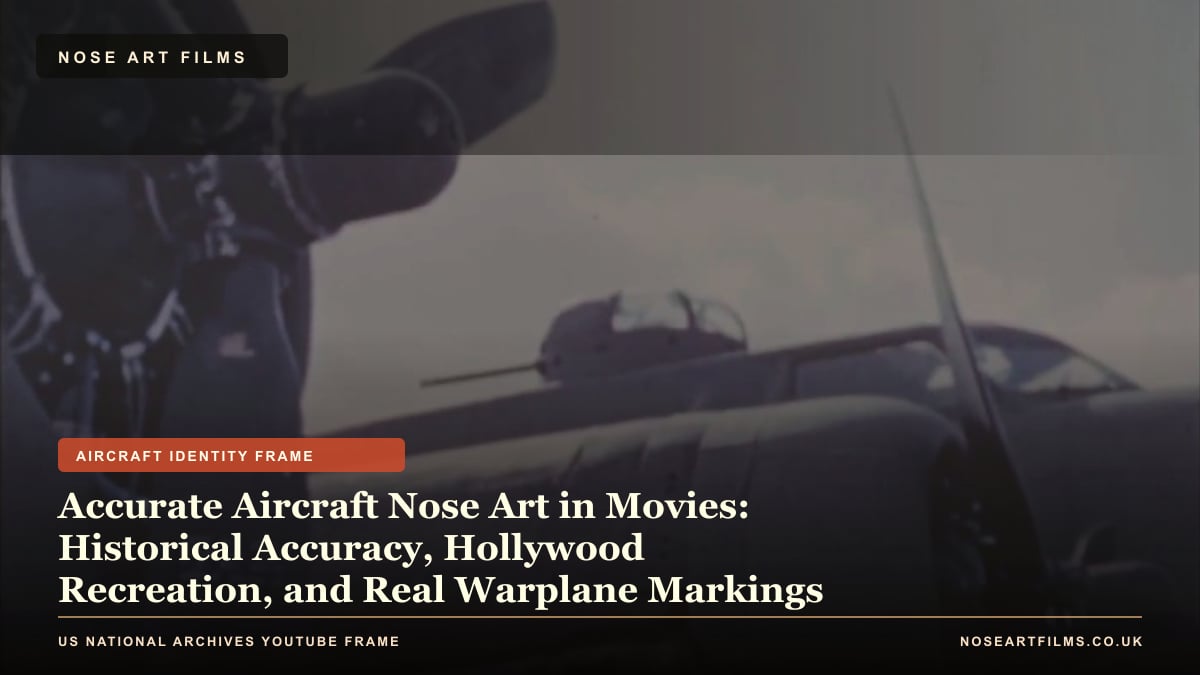
YouTube archival video frame prepared by Nose Art Films for Accurate Aircraft Nose Art in Movies: Historical Accuracy, Hollywood Recreation, and Real Warplane Markings, showing aircraft identity, markings, and film evidence for this blog article.
What Does Accurate Aircraft Nose Art in Movies Mean?
Accurate aircraft nose art in movies means the film artwork matches verified aircraft evidence.
The evidence can come from wartime photographs, museum records, squadron histories, aircraft serial records, restoration files, production notes, and film stills.
What Makes Aircraft Nose Art Historically Accurate in a Movie?
Aircraft nose art is historically accurate when it matches the real aircraft name, artwork, placement, unit, period, and aircraft type.
The strongest movie recreation uses real wartime images or museum-backed references, not only generic bomber art.
What Is the Difference Between Real Aircraft Nose Art and Movie Nose Art?
Real aircraft nose art is wartime artwork painted on an actual aircraft.
Movie nose art is recreated artwork painted, printed, or digitally added for a film. It can be accurate, partly accurate, fictional, censored, or production-driven.
Which Details Matter Most for Aircraft Nose Art Accuracy?
The most important accuracy details are aircraft type, aircraft name, artwork source, placement, squadron code, serial number, mission tally, and paint finish.
The table below shows the main details used to judge aircraft nose art accuracy in movies.
Accuracy Detail
What to Check
Why It Matters
Aircraft type
B-17, B-24, B-25, B-29, P-40, P-51
Nose art placement changes by aircraft
Aircraft name
Memphis Belle, Enola Gay, Bockscar
Name confirms aircraft identity
Artwork source
Pin-up, mascot, slogan, cartoon
Source confirms visual authenticity
Squadron code
Fuselage letters or group marking
Code confirms unit context
Serial number
Aircraft identification number
Serial confirms aircraft record
Paint scheme
Olive drab, natural metal, camouflage
Paint confirms period and theater
Production method
Real aircraft, decal, CGI
Method affects final accuracy
What Are the Most Common Aircraft Nose Art Mistakes in Movies?
The most common aircraft nose art mistakes are wrong aircraft type, wrong artwork placement, modernized art style, missing unit codes, inaccurate paint finish, and censored historical imagery.
These errors appear when a film uses substitute aircraft, reused digital models, simplified markings, or generic production art.
How Can Viewers Verify Movie Aircraft Nose Art Accuracy?
Viewers can verify movie aircraft nose art accuracy by comparing film stills with wartime photographs, museum records, aircraft serials, and squadron histories.
The best verification process is simple:
Identify the aircraft type.
Match the aircraft name.
Compare the nose art.
Check the fuselage code.
Verify the tail marking.
Confirm the serial number.
Separate wartime art from movie recreation.
How Accurate Is WWII Aircraft Nose Art in War Movies?
WWII aircraft nose art in war movies has mixed accuracy.
Some films recreate real wartime aircraft markings. Some films use historically inspired artwork. Some films change aircraft art for readability, censorship, or production limits.
Which War Movies Recreate Aircraft Nose Art Accurately?
War movies recreate aircraft nose art accurately when they use documented aircraft names, verified artwork, and correct unit markings.
Memphis Belle is a strong example because the real aircraft, wartime documentary record, museum display, and 1990 feature film create multiple reference points. The National Museum of the U.S. Air Force says the Memphis Belle nose art was based on a George Petty pin-up illustration and later touched up and repainted by Cpl. Tony Starcer. (The Memphis Belle and Nose Art)
Which War Movies Use Fictional Aircraft Nose Art?
War movies use fictional aircraft nose art when they need story aircraft, composite crews, or simplified screen identities.
Fictional nose art is not automatically inaccurate. It becomes inaccurate when a film presents fictional artwork as the exact marking of a known real aircraft.
Why Do Movies Change Real Aircraft Names, Codes, and Artwork?
Movies change real aircraft names, codes, and artwork for camera readability, legal safety, production continuity, aircraft availability, censorship, and audience sensitivity.
A real wartime aircraft could have small, weathered, explicit, or offensive artwork that a modern film decides to simplify or alter.
How Does Hollywood Nose Art Differ from Wartime Nose Art?
Hollywood nose art is controlled production design.
Wartime nose art was crew-level aircraft expression. The National WWII Museum explains that aircraft nose art varied by air force, aircraft type, and crew culture, and that American aircraft produced one of the largest and most graphic bodies of wartime nose art. (Decoding WWII Plane Nose Art | The National WWII Museum)
How Accurate Is the Nose Art in Memphis Belle 1990?
The nose art in Memphis Belle 1990 is historically based but recreated.
The film uses the real Memphis Belle identity, but the movie aircraft are screen recreations rather than the original wartime aircraft.
Was the Memphis Belle Movie Nose Art Based on Real Wartime Artwork?
Yes. The Memphis Belle movie nose art was based on real wartime B-17F artwork.
The National Museum of the U.S. Air Force identifies the famous Memphis Belle nose art as a representation of a George Petty pin-up illustration from Esquire, with later touch-up and repainting by Cpl. Tony Starcer at Bassingbourn, England. (The Memphis Belle and Nose Art)
What Did Memphis Belle 1990 Get Right About Aircraft Nose Art?
Memphis Belle 1990 got the named-aircraft identity, B-17 bomber context, and recognizable Memphis Belle artwork concept right.
The movie preserved the idea that nose art was not decoration only. It was aircraft identity, crew memory, and public symbol.
What Did Memphis Belle 1990 Get Wrong About B-17 Markings?
The main accuracy limit in Memphis Belle 1990 is substitute-aircraft accuracy.
A substitute B-17 can carry accurate Memphis Belle nose art and still differ from the original B-17F through variant details, turret configuration, surface features, or movie paint.
How Does the Movie Memphis Belle Compare with the Real Aircraft?
The movie Memphis Belle is a screen recreation. The real Memphis Belle is the original B-17F aircraft.
The table below separates the real aircraft from the movie aircraft.
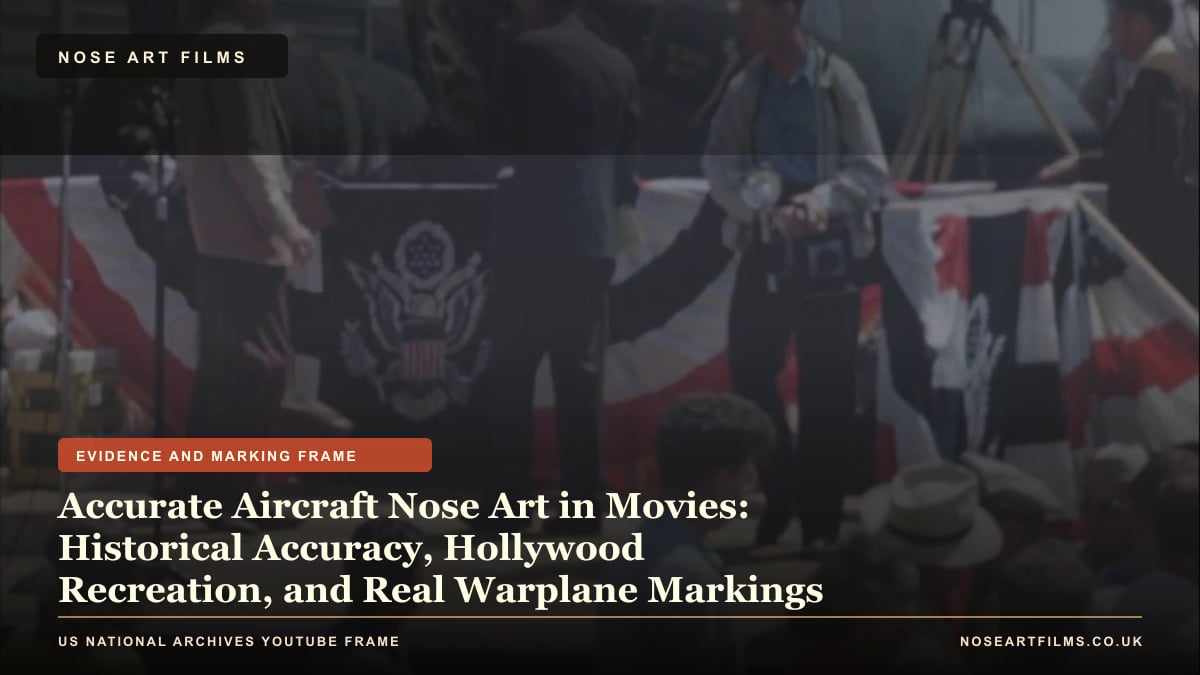
YouTube archival evidence frame prepared by Nose Art Films for Accurate Aircraft Nose Art in Movies: Historical Accuracy, Hollywood Recreation, and Real Warplane Markings, with source status, marking logic, and screen-accuracy cues.
Detail
Real Memphis Belle
Movie Memphis Belle
Aircraft identity
Original wartime B-17F
Substitute film aircraft
Nose art
Wartime artwork
Recreated artwork
Evidence source
Museum and archival record
Film production image
Accuracy issue
Restoration and preservation
Production compromise
Why Is Memphis Belle Important for Movie Nose Art Accuracy?
Memphis Belle is important because it connects real wartime nose art, a famous aircraft, a 1944 documentary, a 1990 feature film, and museum preservation.
Makes Memphis Belle one of the clearest examples for comparing real aircraft nose art with Hollywood recreation.
How Accurate Is the Nose Art in Masters of the Air?
The nose art in Masters of the Air is a researched modern recreation of Eighth Air Force bomber culture.
Apple TV Press describes Masters of the Air as a series centered on the 100th Bomb Group, giving the show a clear B-17 and Eighth Air Force context. (Masters of the Air - Apple TV Press)
Did Masters of the Air Recreate Real B-17 Nose Art?
Masters of the Air recreated historically grounded B-17 markings through production research, digital aircraft, replica interiors, and unit-based visual design.
The recreated artwork is not original wartime paint. It is modern film production based on historical reference.
What B-17 Aircraft Markings Appear in Masters of the Air?
Masters of the Air uses B-17 aircraft names, group markings, unit identity, and bomber artwork connected to the 100th Bomb Group context.
The accuracy question depends on whether each screen aircraft matches a documented wartime aircraft or a historically plausible composite.
What Research Supported Masters of the Air Aircraft Markings?
The strongest research support comes from museum consultation, wartime photographs, 100th Bomb Group records, aircraft profiles, and surviving B-17 references.
How Does Masters of the Air Compare with Real Eighth Air Force Nose Art?
Masters of the Air matches real Eighth Air Force nose art best when it reflects aircraft names, crew culture, unit codes, mission identity, and bomber formation context.
Its main accuracy limit is production method. The series depends on CGI, sets, and replicas rather than a large fleet of real B-17 aircraft.
What Are the Limits of CGI-Based Nose Art Accuracy?
CGI-based nose art accuracy depends on texture quality, reference images, aircraft scaling, shot continuity, weathering, and digital asset reuse.
CGI can improve formation accuracy, but it can reduce accuracy when one aircraft model or marking system is repeated too often.
Did Catch-22 Use Historically Accurate Aircraft Nose Art?
Catch-22 uses historically inspired B-25 nose art, but exact accuracy depends on the version and aircraft being compared.
The 2019 miniseries used real B-25 reference aircraft and digital liveries. VFX supervisor Matt Kasmir said the production digitized two on-location B-25s and created several liveries, including nose art designed by the art department. (CATCH-22: Matt Kasmir - Overall VFX Supervisor - The Art of VFX)
What B-25 Aircraft Nose Art Appears in Catch-22?
Catch-22 aircraft nose art appears as B-25 bomber markings, decals, and individual aircraft identities.
The markings support the medium-bomber setting and the satirical war-film tone.
Was Catch-22 Nose Art Based on Real Wartime B-25 Examples?
Catch-22 nose art is historically inspired rather than always traceable to one verified wartime B-25.
That distinction matters because Catch-22 is satire. A satirical war story can use plausible aircraft art without reproducing one exact wartime aircraft.
How Accurate Are the Aircraft Markings in Catch-22?
The aircraft markings in Catch-22 are plausible for a B-25 screen environment.
Exact accuracy requires comparing each aircraft name, livery, serial number, and marking against wartime B-25 records.
How Does Catch-22 Compare with Other War Films for Nose Art Accuracy?
Catch-22 is stronger for B-25 atmosphere than for exact aircraft-by-aircraft documentation.
Memphis Belle is stronger for one famous real aircraft. Masters of the Air is stronger for large-scale B-17 unit recreation.
How Accurate Is B-17 Nose Art in Movies?
B-17 nose art in movies is accurate when it matches the aircraft name, B-17 variant, nose art placement, group marking, and wartime reference.
B-17 films face accuracy issues because surviving flyable B-17 aircraft are limited and later B-17G airframes may represent earlier B-17F aircraft.
Why Is B-17 Nose Art Common in WWII Aviation Movies?
B-17 nose art is common in WWII aviation movies because B-17 bombers became strong visual symbols of American daylight bombing, crew identity, and named-aircraft storytelling.
Memphis Belle, 100th Bomb Group aircraft, and other named B-17s give filmmakers recognizable visual anchors.
What B-17 Nose Art Examples Are Most Recreated in Films?
The most recreated B-17 nose art examples are documented, famous, and visually recognizable aircraft.
Memphis Belle is the strongest example because the artwork, aircraft identity, documentary record, and museum record are widely known. (The Memphis Belle and Nose Art)
How Accurate Are B-17 Movie Markings?
B-17 movie markings are accurate when the film matches nose art, squadron code, serial number, tail marking, paint scheme, and variant features.
The most common problem is using a visually similar aircraft that does not match the exact historical airframe.
How Do B-17F and B-17G Differences Affect Movie Accuracy?
B-17F and B-17G differences affect movie accuracy because visible features can reveal the wrong variant.
The B-17G chin turret is a major recognition feature. A film portraying an earlier B-17F with a later B-17G needs visual modification or careful framing.
How Accurate Is B-24 Liberator Nose Art in Movies?
B-24 Liberator nose art in movies is accurate when the artwork fits the B-24's shape, placement, unit, theater, and crew culture.
The B-24 had different nose and fuselage surfaces from the B-17, so its artwork appeared with different scale and placement.
How Did B-24 Nose Art Differ from B-17 Nose Art?
B-24 nose art differed through aircraft shape, fuselage space, nose layout, and theater usage.
Some B-24 art used large side-fuselage compositions rather than compact nose-only designs.
Why Did B-24 Nose Art Have Different Placement and Scale?
B-24 nose art had different placement because the aircraft's nose shape, cockpit layout, gun positions, and fuselage surfaces differed from the B-17.
Movie recreations must match the aircraft geometry, not only the artwork style.
What Famous B-24 Nose Art Examples Appear in Research and Film References?
Famous B-24 nose art examples include aircraft such as The Dragon and His Tail and other documented Liberator artworks.
These examples help researchers compare bomber art outside the B-17-centered movie tradition.
How Do Movies Recreate B-24 Liberator Nose Art?
Movies recreate B-24 Liberator nose art through archival photographs, aircraft profiles, model references, decals, digital textures, and restored aircraft references.
The main challenge is aircraft availability because B-24 flying examples are rarer than typical film needs.