How Is Nose Art Shown Across Hollywood War Movie Types?
Nose art is shown differently across Hollywood war films, WWII films, aviation movies, bomber movies, fighter-pilot movies, air combat movies, and military aviation movies.
YouTube archival video frame prepared by Nose Art Films for How Is Nose Art Shown Across Hollywood War Movie Types?. Source: Sources and Visual Credits.
Nose art is shown differently across Hollywood war films, WWII films, aviation movies, bomber movies, fighter-pilot movies, air combat movies, and military aviation movies.
This table shows how Hollywood war movie type changes nose art function and accuracy risk.
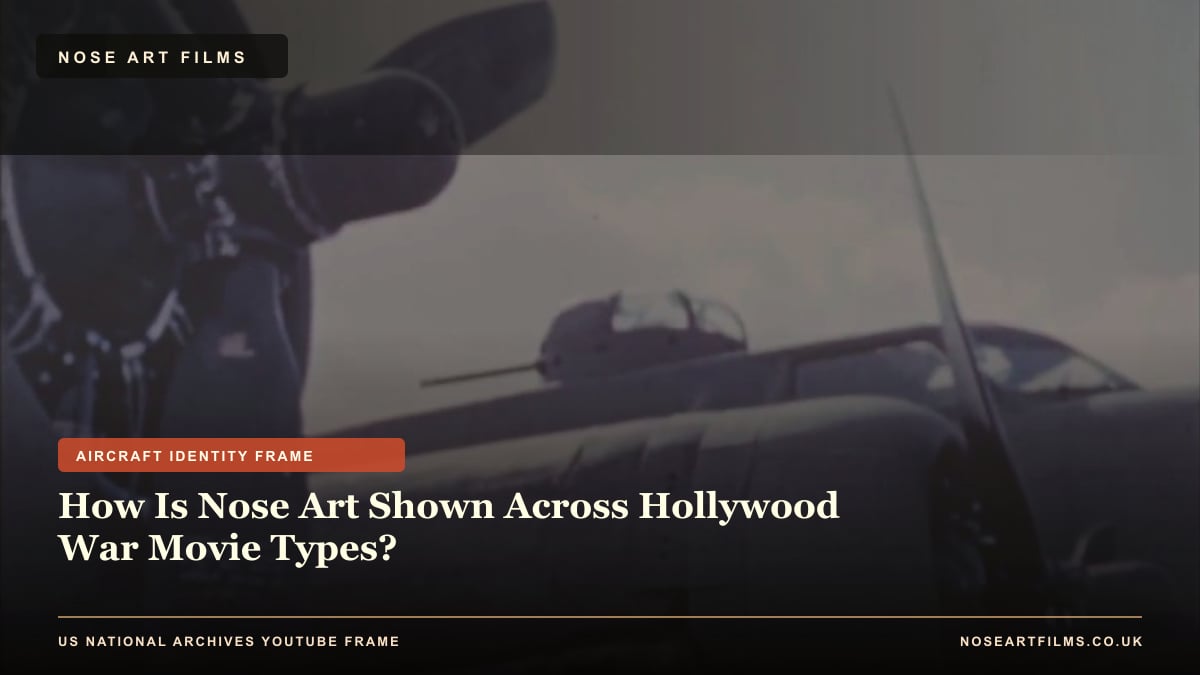
YouTube archival video frame prepared by Nose Art Films for How Is Nose Art Shown Across Hollywood War Movie Types?, showing aircraft identity, markings, and film evidence for this blog article.
Hollywood Movie Type
Nose Art Function
Accuracy Risk
War films
Military atmosphere and crew identity
Generic markings
WWII films
Wartime aircraft personalization
Wrong aircraft or timeline
Aviation movies
Aircraft identity and flight atmosphere
Decorative treatment
Bomber movies
Crew identity and mission tallies
Wrong mission count
Fighter-pilot movies
Pilot identity and kill markings
Bomber logic applied to fighters
Air combat movies
Fast aircraft recognition
Repeated CGI markings
Military aviation movies
Unit culture and aircraft markings
Confused marking systems
How Is Nose Art Shown in Hollywood War Films?
Nose art is shown in Hollywood war films as military atmosphere, aircraft identity, crew culture, and emotional storytelling.
War films use nose art to make aircraft specific rather than generic.
How Is Nose Art Shown in Hollywood WWII Films?
Nose art is shown in Hollywood WWII films through aircraft names, mascots, pin-up figures, mission tallies, squadron markings, and crew identity.
How Is Nose Art Shown in Hollywood Aviation Movies?
Nose art is shown in Hollywood aviation movies as aircraft identity, aviation atmosphere, and visual connection to flight.
Aviation movies may treat nose art as a technical marking, story symbol, or historical detail.
How Is Nose Art Shown in Hollywood Bomber Movies?
Nose art is shown in Hollywood bomber movies as larger, crew-centered, mission-linked, and aircraft-name-based.
Bomber nose art supports:
Crew identity.
Mission tallies.
Aircraft attachment.
Group survival.
Aircraft-as-character storytelling.
How Is Nose Art Shown in Hollywood Fighter Pilot Movies?
Nose art is shown in Hollywood fighter pilot movies through smaller, pilot-centered markings.
Fighter-pilot movies use:
Pilot names.
Kill markings.
Unit colors.
Squadron symbols.
Shark-mouth art.
Personal insignia.
Fighter markings should not be forced into bomber nose art patterns.
How Is Nose Art Shown in Hollywood Air Combat Movies?
Nose art is shown in Hollywood air combat movies as a fast recognition tool for aircraft identity and scene continuity.
Air combat movies rely on large visual markers because aircraft move quickly and appear in groups.
How Is Nose Art Shown in Hollywood Military Aviation Movies?
Nose art is shown in Hollywood military aviation movies as part of aircraft marking systems, combat identity, unit culture, and operational atmosphere.
Military aviation movies need to separate personal aircraft art from official markings.
How Does Genre Affect Nose Art Accuracy in Hollywood War Movies?
Genre affects nose art accuracy because documentary-style films require stronger evidence, Hollywood dramas balance story with realism, and fictional war movies use plausible but undocumented art.
The strongest genre-specific accuracy appears when the movie identifies whether the aircraft is real, restored, recreated, inspired, or fictional.
How Does Hollywood Recreate Aircraft Nose Art?
Hollywood recreates aircraft nose art through research, aircraft identification, art department design, practical painting, CGI texture work, weathering and continuity tracking.
This table shows the production process for Hollywood aircraft nose art.
Production Stage
Work Done
Accuracy Purpose
Research
Collect photos and records
Find real or plausible art
Verification
Check aircraft identity
Avoid wrong markings
Design
Create artwork and marking sheets
Prepare screen-ready art
Practical painting
Paint aircraft, props, panels, or mockups
Create physical texture
CGI texture work
Apply digital markings
Build aerial scenes
Weathering
Add chips, stains, and damage
Match wartime use
Continuity
Track aircraft identity
Avoid mismatched scenes
How Do Hollywood War Movies Recreate Nose Art?
Hollywood war movies recreate nose art by moving from evidence to design, then from design to physical or digital execution.
The workflow has 8 steps:
Collect references.
Verify aircraft identity.
Design the artwork.
Prepare marking sheets.
Paint or texture the aircraft.
Add weathering.
Track continuity.
Review final accuracy.
How Do Movie Art Departments Create Aircraft Nose Art?
Movie art departments create aircraft nose art with reference boards, sketches, aircraft names, lettering studies, marking sheets, and final paint or texture guides.
The art department turns historical reference or fictional story needs into production-ready aircraft artwork.
How Is Aircraft Nose Art Painted for Hollywood Movies?
Aircraft nose art is painted for Hollywood movies on restored aircraft, prop aircraft, panels, mockups, replicas, miniatures, and full-size sets.
Common methods include:
Surface preparation.
Stencils.
Decals.
Freehand painting.
Scenic aging.
Weathering.
Continuity photography.
Practical painting gives aircraft art real surface texture.
How Do Prop Teams Paint Nose Art in Hollywood War Movies?
Prop teams paint nose art on physical aircraft surfaces, panels, or mockups.
Prop teams follow art department references and continuity sheets so aircraft name, markings, damage, and weathering stay consistent.
How Do Scenic Painters Create Aircraft Nose Art?
Scenic painters create aircraft nose art by adding hand-painted texture, uneven edges, faded color, chipped paint, stains, scratches, and aged surfaces.
YouTube archival evidence frame prepared by Nose Art Films for How Is Nose Art Shown Across Hollywood War Movie Types?, with source status, marking logic, and screen-accuracy cues.
Scenic painting makes fresh production art look field-painted and wartime-used.
How Does CGI Recreate Aircraft Nose Art in Hollywood Movies?
CGI recreates aircraft nose art through 3D aircraft models, UV mapping, digital textures, serial-number layers, weathering maps, and compositing.
CGI can create large aircraft formations, but CGI increases the risk of repeated names, duplicated serial numbers, and inconsistent damage patterns.
How Do Restored Aircraft Affect Hollywood Nose Art?
Restored aircraft affect Hollywood nose art by providing real scale, real surface reflections, and authentic mechanical presence.
Restored aircraft can also create accuracy problems because restored aircraft may carry:
Postwar paint.
Museum interpretation.
Owner restrictions.
Preservation limits.
Temporary markings.
Modern safety requirements.
A restored aircraft is not automatically an exact wartime aircraft.
How Do Replica Aircraft Get Nose Art in Hollywood Movies?
Replica aircraft get nose art through production artwork, historical references, stencils, decals, scenic painting, and continuity checks.
A replica is accurate when markings match aircraft shape, panel lines, side placement, unit context, and scene date.
How Does Hollywood Weather and Age Aircraft Nose Art?
Hollywood weathers and ages aircraft nose art with faded paint, chipped edges, dirt, exhaust stains, oil marks, scratches, patched panels, and battle damage.
Weathering should match aircraft age, mission history, base conditions, and scene date.
How Do VFX Teams Keep Aircraft Markings Consistent?
VFX teams keep aircraft markings consistent by tracking each aircraft as a unique digital asset.
Each aircraft needs:
Aircraft name.
Serial number.
Squadron code.
Tail code.
Nose art.
Mission tally.
Damage state.
Weathering state.
Scene list.
This prevents aircraft identity errors across shots.
How Do Production Designers Choose Aircraft Names in Hollywood War Movies?
Production designers choose aircraft names as real, inspired, or fictional names.
A strong aircraft name fits:
Period language.
Aircraft type.
Unit culture.
Theater.
Character identity.
Story function.
A fictional aircraft name can remain plausible when it follows wartime naming patterns.
Why Does Hollywood Change Real Nose Art?
Hollywood changes real nose art because of storytelling, fictional aircraft, legal clearance, ratings, screen readability, missing evidence, simplified markings and composite aircraft identities.
Why Do Hollywood War Movies Change Real Aircraft Nose Art?
Hollywood war movies change real aircraft nose art for story clarity, production design, ratings, legal clearance, and audience recognition.
A practical change becomes an accuracy problem when a movie presents changed art as documented aircraft evidence.
Why Does Hollywood Invent Aircraft Nose Art?
Hollywood invents aircraft nose art for fictional aircraft, composite crews, missing evidence, symbolic storytelling, and character identity.
Invented art works when the movie does not present the aircraft as a documented real aircraft.
Why Does Hollywood Use Fictional Aircraft Names?
Hollywood uses fictional aircraft names to help viewers track aircraft, characters, and mission stakes.
A fictional name can support:
Character identity.
Story clarity.
Emotional symbolism.
Legal safety.
Composite storytelling.
The name remains plausible when it fits aircraft type, time period, theater, and unit culture.
Why Does Hollywood Use Fictional Nose Art?
Hollywood uses fictional nose art when the aircraft is invented, the crew is fictional, or the story combines several real events.
Fictional nose art is not automatically inaccurate. It becomes inaccurate when presented as real historical aircraft art without evidence.
Why Is Hollywood Nose Art Sanitized?
Hollywood nose art is sanitized because of ratings, broadcast standards, streaming policies, cultural sensitivity, legal review, and modern audience expectations.
This issue applies to pin-up nose art.
Why Is Pin-Up Nose Art Changed in Hollywood Movies?
Pin-up nose art is changed in Hollywood movies because of nudity standards, ratings, rights issues, platform rules, or modern display concerns.
When pin-up art changes, the movie needs to preserve aircraft period context.
Why Are Background Aircraft Markings Generic in Hollywood Movies?
Background aircraft markings are generic because background aircraft are seen briefly, reused in CGI, or created from shared texture assets.
Generic markings can create:
Repeated serial numbers.
Duplicated nose art.
Wrong unit codes.
Inconsistent aircraft identities.
Why Does Hollywood Simplify Aircraft Markings?
Hollywood simplifies aircraft markings for camera distance, budget, time, readability, and continuity.
Simplification helps scene comprehension. Too much simplification weakens historical detail.
Why Is Hollywood Nose Art Adjusted for Screen Readability?
Hollywood nose art is adjusted for screen readability when filmmakers change size, contrast, color, line thickness, lighting, or framing.
Readability supports accuracy when it keeps aircraft identity intact.
Why Does Hollywood Create Composite Aircraft Identities?
Hollywood creates composite aircraft identities to combine multiple real aircraft, crews, missions, or events into one story aircraft.
Composite aircraft help storytelling but reduce aircraft-specific accuracy.
Why Does Hollywood Use Historically Plausible but Undocumented Nose Art?
Hollywood uses historically plausible but undocumented nose art when a production wants period accuracy without claiming exact aircraft evidence.
Plausible artwork fits the time, aircraft type, unit culture, theater, placement, and weathering.
How Does Aircraft Type Affect Nose Art in Hollywood War Movies?
Aircraft type affects nose art because each aircraft has different shape, role, surface area, theater, unit culture, and marking rules.
A B-17, B-24, B-25, B-29, P-40, P-47, and P-51 should not use one shared nose art logic.
How Is B-17 Nose Art Shown in Hollywood War Movies?
B-17 nose art is shown in Hollywood war movies through Flying Fortress identity, bomber crews, Eighth Air Force context, mission tallies, aircraft names, and Memphis Belle -style recognition.
The National Museum of the U.S. Air Force documents the Memphis Belle as a Boeing B-17F and treats its nose art as part of the aircraft's public history. (The Memphis Belle and Nose Art)
How Is B-24 Nose Art Shown in Hollywood War Movies?
B-24 nose art is shown in Hollywood war movies through Liberator identity, heavy bomber missions, fuselage shape, and marking placement.
Hollywood becomes more accurate when B-24 artwork is not treated as identical to B-17 artwork.
How Is B-25 Nose Art Shown in Hollywood Movies?
B-25 nose art is shown in Hollywood movies through medium bomber context, Pacific or Mediterranean settings, lower-altitude operations, and aircraft scale.
B-25 art works best when it reflects medium-bomber role and theater context.
How Is B-29 Nose Art Shown in Hollywood War Movies?
B-29 nose art is shown in Hollywood war movies through late-war Pacific context, long-range bombing, aircraft names, and different marking logic from European bomber movies.
B-29 markings become weaker when copied directly from B-17 or B-24 visual patterns.
How Is P-40 Shark-Mouth Nose Art Shown in Hollywood Movies?
P-40 shark-mouth nose art is shown in Hollywood movies as fighter aggression imagery and strong visual identification.
Hollywood uses shark-mouth art to communicate danger, speed, and combat identity.
How Is P-47 Nose Art Shown in Hollywood War Movies?
P-47 nose art is shown in Hollywood war movies through fighter-bomber identity, pilot names, unit markings, kill markings, and squadron context.
The P-47 works as a fighter aircraft, not as a bomber-style nose art platform.
How Are P-51 Aircraft Markings Shown in Hollywood Movies?
P-51 aircraft markings are shown in Hollywood movies through escort-fighter identity, pilot names, squadron colors, unit markings, and kill markings.
P-51 markings need pilot and unit context.
How Is Bomber Nose Art Shown in Hollywood War Movies?
Bomber nose art is shown in Hollywood war movies as larger, crew-centered, aircraft-name-based, and mission-linked.
Bomber movies use nose art to show crew memory and mission repetition.
How Is Fighter Aircraft Nose Art Shown in Hollywood War Movies?
Fighter aircraft nose art is shown in Hollywood war movies as smaller, pilot-centered, victory-linked, and squadron-linked.
Fighter movies rely more on markings than large painted figures.
How Should Heavy Bomber Nose Art Differ from Medium Bomber Nose Art?
Heavy bomber nose art differs from medium bomber nose art by aircraft scale, mission type, surface area, formation use, and theater context.
Heavy bombers show larger aircraft names, mission tallies, and crew-centered markings. Medium bombers need smaller aircraft-specific placement and theater-specific markings.
How Should Fighter Markings Differ from Bomber Nose Art in Hollywood War Movies?
Fighter markings differ from bomber nose art because fighters and bombers used different visual systems.
Aircraft Role
Nose Art Pattern
Main Accuracy Risk
Heavy bomber
Large artwork, crew name, mission tally
Wrong mission count
Medium bomber
Smaller aircraft art, mission context
Heavy-bomber style copied incorrectly
Fighter
Pilot name, unit color, kill marking
Bomber-style art forced onto fighter
Fighter with shark-mouth art
Aggressive visual identity
Wrong aircraft or unit context
How Do American, RAF, and Luftwaffe Aircraft Markings Differ in Hollywood Movies?
American, RAF, and Luftwaffe aircraft markings differ by air force, unit system, insignia, code structure, and nose art tradition.
Hollywood should not apply USAAF-style nose art to every aircraft. The National WWII Museum states that different participating air forces had their own nose art styles or forms shaped by national culture. (Decoding WWII Plane Nose Art | The National WWII Museum)